




Volume 213 - Issue 5
Telehealth in cancer care during the COVID‐19 pandemic
Authors: Zee Wan Wong and Hannah L Cross
Med J Aust 2020; 213 (5): 237-237.e1. || doi: 10.5694/mja2.50740
Published online: 7 September 2020
Published online: 7 September 2020
To the Editor: The coronavirus disease 2019 (COVID‐19) pandemic has required rapid adjustments in health service delivery.1 The Victorian COVID‐19 Cancer Network (VCCN) is a joint initiative of the Victorian Comprehensive Cancer Centre and Monash Partners Comprehensive Cancer Consortium. Through expert groups, the VCCN aims to provide support and advice to clinicians and health care services treating cancer patients during the pandemic.
The VCCN Telehealth Expert Working Group conducted a survey to understand the barriers and enablers to the rapid adoption of telehealth in health services during the first week of April 2020. Seventeen cancer services from across metropolitan and regional Victoria and Tasmania responded. Notably, all respondent cancer services had implemented some form of telehealth since the pandemic. Healthdirect, the Victorian Department of Health and Human Services’ supported telehealth platform, was used in 40% of services, with 25% using phone only and others using platforms such as Skype, FaceTime and doxy.me.
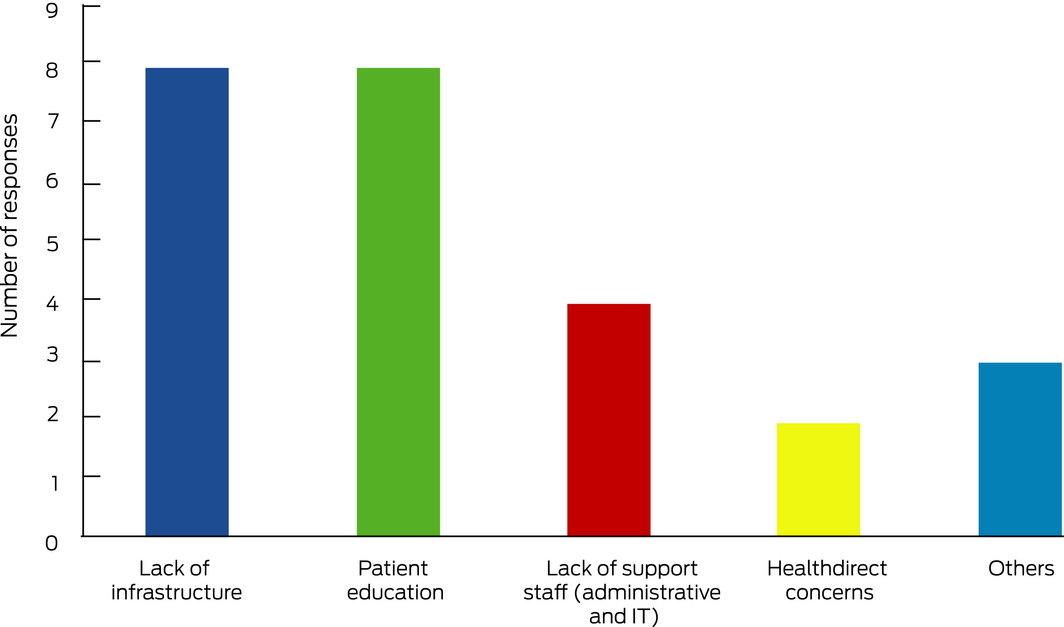
With the unprecedented increase in the uptake of telehealth,2 there is a tremendous opportunity to integrate telehealth into routine practice, potentially improving inequities and inefficiencies in the delivery of cancer care for suitably selected patients. Our survey results suggest several areas for attention to support telehealth, including the need for further investment in information technology infrastructure across health services and administrative support to facilitate changes in practice and workflow (Box).
The survey results also highlight the educational and training needs of consumers and health professionals during telehealth implementation. Aboriginal and Torres Strait Islanders, people from culturally and linguistically diverse backgrounds and of lower socio‐economic status, and older patients may have greater needs and will require additional support from both government and relevant organisations to ensure equity of access to cancer care via telehealth.
We strongly advocate the need to establish evidence‐based, patient‐centred and sustainable telehealth in cancer management. Research into the experience of patients and clinicians should be prioritised to ensure the consistent quality of telehealth consultation with face‐to‐face consultation in appropriate clinical circumstances.
Competing interests
Both authors are members of the VCCN Telehealth Expert Working Group.
Acknowledgements
We thank the VCCN Telehealth Expert Working Group and Clinical Directors Group, and the Victorian Department of Health and Human Services.
References
- Australian Government Department of Health. Impact of COVID‐19 in Australia – ensuring the health system can respond. https://www.health.gov.au/resources/publications/impact-of-covid-19-in-australia-ensuring-the-health-system-can-respond (viewed June 2020).
- Boyages S. COVID‐19 consequence: telehealth will go mainstream. InSight+ 2020; 20 Apr. https://insightplus.mja.com.au/2020/15/covid-19-consequence-telehealth-will-go-mainstream/ (viewed June 2020).
From Ambition to Action: Closing Policy, Equity and Implementation Gaps in the Australian Cancer Plan's ‘Enhanced Consumer Experience’
Carla Thamm, Elise Button, Oluwaseyifunmi A. Agbejule, Reegan Knowles, Karen van Gorp, Mark B. Pinkham, Meinir Krishnasamy, Alexandra L. McCarthy, Raymond J. Chan
Sovereignty and Survival: Understanding Lung Cancer Outcomes for Aboriginal and Torres Strait Islander People in Australia, a Case–Control Study
Alice R. T. Bergin, Luc te Marvelde, Roger L. Milne, Benjamin J. Solomon, Kris Ivanova, Peter Savas, Stephen J. Luen, Jay Hamann, Andrea Casey, Nicole Watt, Sue M. Evans, Gail Garvey, Sherene Loi
The Changing Indications for Adult Liver Transplantation in Australia: A Narrative Review
Fadak Mohammadi, Alan J. Wigg, Ken Liu, Simone I. Strasser
Uneven Ground: Survival Differences Among Victorian Lung Cancer Patients by Location of Residence (2011–2023): A Retrospective Cohort Study
Evangeline Samuel, Eldho Paul, Mike Lloyd, Sanuki Tissera, Craig Underhill, Sagun Parakh, Phillip Parente, Inger Olesen, Javier Torres, Katharine See, Gavin M. Wright, David Langton, Thomas John, Matthew Conron, James Bartlett, Nicola Atkin, Nikolajs Zeps, Susan V. Harden, Wasek Faisal, John R. Zalcberg, Rob G. Stirling
Early-Onset Colorectal Cancer With Liver-Only Metastases: A Retrospective Cohort Study Integrating Prospectively Collected Real-World Clinical and Molecular Data From an Australian National Database (2009–2024) to Guide Treatment Planning
Savio G. Barreto, Christos S. Karapetis, Shahid Ullah, Matthew Burge, Susan Caird, Angus Campbell, Azim Jalali, Ross Jennens, Muhammad A. Khattak, Belinda Lee, Stephanie H. Lim, Shehara Mendis, Louise Nott, Timothy J. Price, Jeremy D. Shapiro, Jeanne Tie, Javier Torres, Colin Williams, Rachel Wong, Vanessa Wong, Peter Gibbs
Australian Pathways for Specialist Pain Management and Early Palliative Care for People With Pancreatic Cancer: Developed Using a Community Consensus Approach
Jennifer Philip, Melanie R. Lovell, Kylee Bellingham, Gail Garvey, Gregory B. Crawford, Nicole M. Rankin, Kara Burns, Isabel Young, Vivienne Milch, Dorothy Keefe, Katrina Anderson, James Lawson, Meinir Krishnasamy